In working with children who are, what I call, “bright” as well as those who are “highly sensitive,” I have noticed that many exhibit characteristics of ADHD.
Some of the social and emotional features of “gifted” individuals, as well as those with ADHD, are similar. They include anxiety, perfectionism, emotional intensity, heightened sensitivity, excitability, and innovative thinking. Interestingly, many of the bright families I work with often contain at least 1 - 2 family members who also exhibit the classic diagnostic criteria for ADHD ie. distractibility, impulsivity and high need for movement.
I have observed that these individuals often struggle with the executive skills that are necessary for completing tasks, although there is often great depth in their thinking. Sadly, many of these children do not feel smart or good about who they are. Each quietly compares themselves to others who are not like them. I believe that this thinking stems from our society’s tendency to view “difference” as “disorder.” No matter how strength-based we may try to be, the word “disorder” itself implies weakness. Thinking of oneself as abnormal can actually increase anxiety which, in turn, exacerbates the negative aspects of these neurological differences.
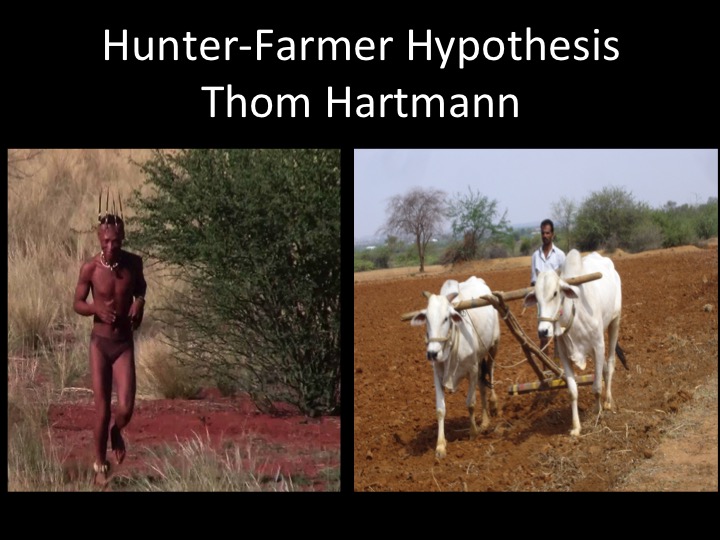
So it was a beautiful day when I stumbled upon Thom Hartmann’s Hunter-Farmer Hypothesis. Hartmann suggests that the characteristics we now associate with ADHD are actually evolutionary adaptations that were highly beneficial to ancient hunter-gatherer societies. As our world has continued to rapidly change, this adaptation has become more and more problematic within the context of our current culture. The heritable characteristics of ADHD may be precipitated by the elements of our modern world which make it difficult for people to get their intrinsic needs met. These needs include adequate sunlight, vital nutrients, and physical exercise. Many individuals with characteristics of ADHD are deficient in Vitamin D, Omega 3 fatty acids and Magnesium. Many years ago, those nutrients would have been naturally provided through the environment.
Hartmann’s hypothesis is based on society’s ancient roots as nomadic hunter-gatherers. The introduction of agriculture resulted in most people taking on the farming lifestyle and, therefore, adapting to a more routined way of living. Hartmann asserts that while most humans adapted traits to the agricultural lifestyle, those with the characteristics of ADHD retained many of the ancient hunter traits. Some of those traits are distractibility, impulsivity, and a high need for movement. In ancient hunter-gatherer societies, these traits would have been necessary for scanning the environment, making quick life-or-death decisions, escaping predators and pursuing prey.
Hartmann’s hypothesis may provide some explanation for the recent and dramatic rise in the number of children being diagnosed with ADHD. Could it be possible that our world is changing so rapidly that the people who have inherited this neurological type are finding it increasingly difficult to get their needs met, and therefore, are struggling more? You can read more about the Hunter-Farmer Hypothesis in Hartmann’s book, Attention Deficit Disorder: A Different Perception.
Hartmann's hypothesis makes sense to me. What doesn’t make sense is the ever-growing number of children who are being diagnosed with a label that contains the word “disorder” in the title.
My work centers on helping children and families to better understand themselves while recognizing the strengths that lie within their neurological differences. In doing so, I found it very difficult to help a child gain a better understanding of him/herself within the context of disorder. So I decided to write a story called for children based on Hartmann’s Hunter-Farmer Hypothesis. When I read that story to children, their eyes lit up and they often asked me to read it again. The response was so positive that I decided to make it into a video. That video is now available on my website as part of “The Young Hunter Survival Kit.” The kit is $24.95 and includes family discussion questions, a document called Tips for Optimal Focus and another one called “Tools for Parenting Young Hunters.”
If you are a parent interested in purchasing, please click here to go to that page on my website. www.guidingbright.com/store/the-young-hunter-survival-kit.
If you are a professional, school or organization, you may be interested in purchasing “The Young Hunter Student Survival Kit.” If so, click here. www.guidingbright.com/store/for-schools-and-organizations
I am not alone in this work. My colleague, Michael Ferguson, has written an incredible book for adults with ADHD characteristics based on the Hunter-Farmer Hypothesis. It is a great resource full of natural tips for maximizing “hunter-type” strengths and mitigating the accompanying struggles. In addition to his book, Michael hosts a podcast that is uplifting and helpful. I was recently honored to be his guest in an episode titled, “Raising Hunter-Type Children.” You can access it by clicking here. www.drummerandthegreatmountain.com/adult-adhd-add-tips-and-support-podcast-raising-hunter-type-children-with-tina-harlow
I have worked in the field of mental health for many years. I sincerely believe that it is time for a positive shift in how we view each other. The future of our bright children depends on it.